
If You Died Tonight, Are You 100% Sure You Would Be With God Forever?
If you are not 100% sure, watch the 4-minute video and read the text below. PLEASE take the time and be sure you have the right answer. Tomorrow is not promised.
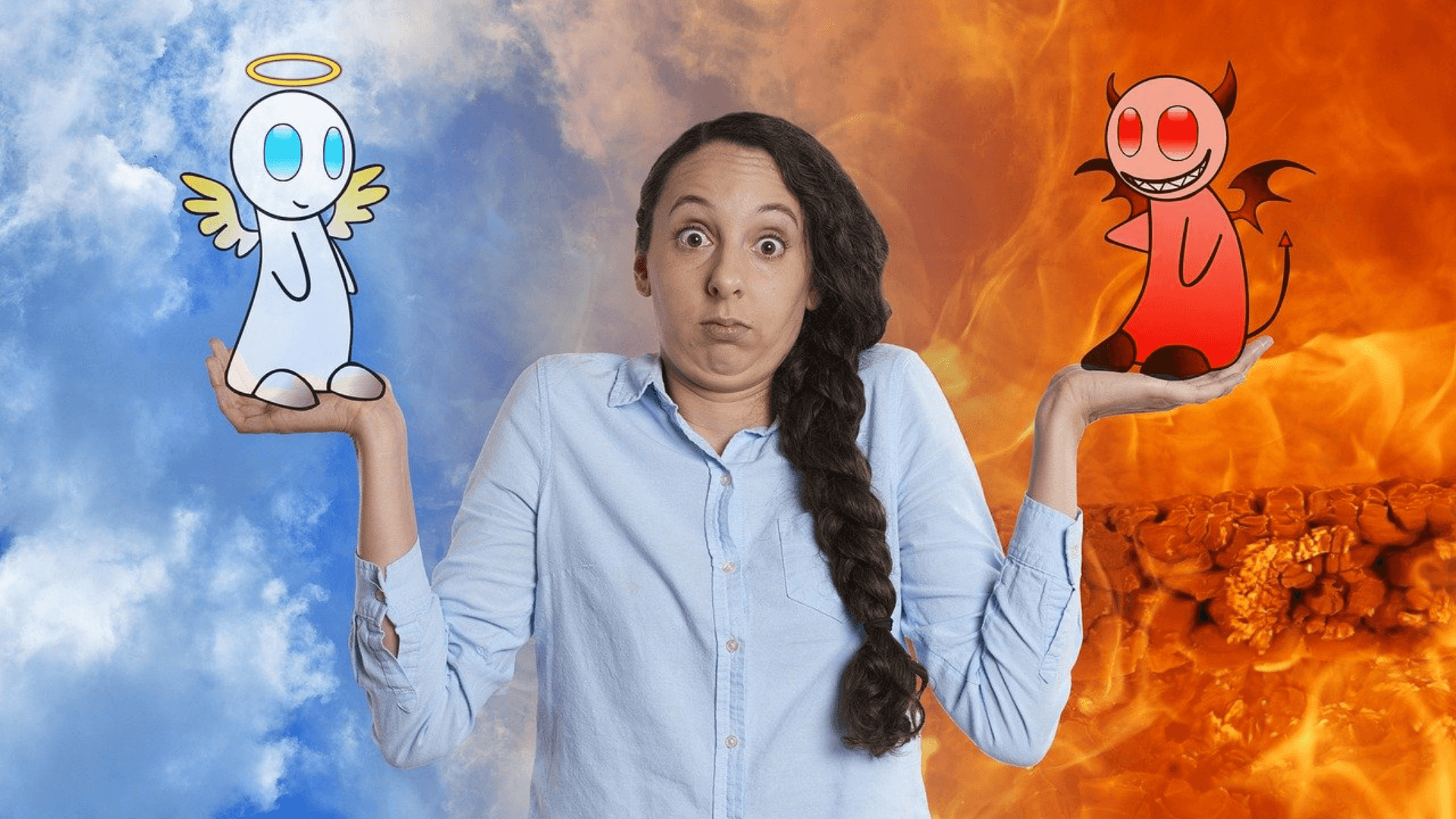
Jesus Christ claims He is the ONLY WAY to be with God forever and have eternal life.
John 14:6 – “I (Jesus) am the way, and the truth, and the life. No one comes to the Father but through Me.”
A few other claims made by Jesus: John 4:10-29; 6:35-40; 8:12-56, 57-58; 10:7-14; 11:25-27; 15:1-11
But should we care? Who’s to say Jesus’ claims are actually true? Should we even use the Bible as a trustworthy source of information? Wait, does God and eternal life really exist?
Here are a few reasons why we should take Jesus’ claims and the Bible as a whole—seriously:
1. Christianity is Based on an Event
If Jesus really did die on a cross and rise from the dead on the third day as He predicted (Matt. 16:21; 12:39-40 | John 2:18-22; 10:17-18), it confirms He is who He claims to be and ALL His words are true.
Why? Jesus claimed to be the I AM, Son of God, one with the Father, giver of eternal life, and the Messiah (the Savior who takes away the sin of the world). It is also written that He was without sin (2 Cor. 5:21 | 1 John 3:5 | Heb. 4:15) which is the only way a perfect sacrifice and God raising Him from the dead permanently could have occurred (Heb. 10:1-18 | Acts 2:24; 17:30-31).
If Jesus did not rise from the dead, that means he is not actually who he said he was and we do not need to listen to him. But if Jesus did rise from the dead, we best follow what He says because eternal salvation and the afterlife depends on it (John 8:21-24; 10:37-38 | 1 Cor. 15:12-28 | Rev. 1:17-18).
2. Did the Event Actually Happen?
If you want to prove Christianity false, your entire argument needs to start and end with this. However, modern atheist scholars do not even dispute that Jesus existed and died on a cross. For example, “Jesus’ death as a consequence of crucifixion is indisputable” (Atheist Scholar – Gerd Lüdemann).
For the resurrection, Jesus was raised to life on the third day and was seen by more than 500 of His followers after His death (1 Cor. 15:3-5, 6-8 | Acts 13:23-31). After Jesus ascended into Heaven (Acts 1:1-3, 9-11 | Luke 24:50-53), His disciples continued to preach and teach that He is alive, even up to the point of death from persecution which demonstrates they were not just making it up. There is also an empty tomb to confirm the story (Matt. 28:5-7; 11-15).
To go deeper on the subject, two great books to read are The Case for Christ by Lee Strobel and More Than A Carpenter by Josh McDowell.
3. Divine Authenticity of the Bible
The Bible is the world’s best-selling book of ALL time.
- It is a collection of 66 books (39 Old Testament, 27 New Testament) (Rom. 3:1-2)
- written over a period of roughly 1,400 to 1,600 years
- covering more than 4,000 years of human history
- and claims to be divinely inspired while being written by men (2 Tim. 3:16)
The New Testament has more than 5,800 Greek manuscripts and over 20,000 additional manuscripts in other ancient languages, far more full and partial manuscripts than any other work of ancient literature. Despite minor differences, carefully cross-checking the manuscripts shows that the text has remained consistent and reliable over time.
There are also thousands of archeological finds that historically support people, places, and cultural details in the Bible. In fact, there are zero valid archeological finds that have ever contradicted a Biblical account.
Watch this video highlighting a few of these archaeological finds, including the Shroud of Turin. There is strong evidence pointing to the Shroud being the burial cloth Jesus was wrapped in (Matt. 27:59, Mark 15:46, Luke 23:53, John 19:40; 20:5–7). As such, it stands as concrete, historical evidence of the resurrection, beyond the other overwhelming evidence we already have.
Also, check out a few video overviews of the Bible, from Genesis to Revelation:
Summary 1 | Summary 2 | Summary 3 | AI Animated Bible Movie | Bible Stories Compilation
4. Prophecy in the Bible
There are 300+ prophetic scriptures in the Old Testament dealing with the birth (Isa. 9:6-7), ministry (Luke 4:16–21), death (Isa. 53:3-12), and resurrection (Psalm 16:8-11) of Jesus Christ. These accounts were recorded centuries before Jesus came to earth, and every word has been fulfilled (Acts 3:18 | Luke 24:25-27, 44-49 | 2 Peter 1:20-21).
View a few more examples of these prophecies.
The odds of just eight of these prophecies being fulfilled in one human is 1 in 100,000,000,000,000,000 (1 in 1017). For one person fulfilling only 48 prophecies, it is 1 in 10157. This is not only substantial evidence that Jesus is the Messiah (John 1:40-41 | Acts 5:42), but also shows the Bible’s supernatural authority.
5. Evidence of God's Existence
A house does not build itself. Its existence, structure, order, and purpose point beyond itself to a builder. Scripture takes that ordinary reasoning to its ultimate conclusion: creation points to a Creator.
We naturally reason from effects to adequate causes everywhere else in life. A building points to a builder, a painting to a painter, and meaningful information to intelligence. Likewise, a universe that exists, had a beginning, operates according to intelligible laws, displays extraordinary precision and order, and contains conscious moral beings requires an adequate explanation.
The foundational question is simple: Why is there something rather than nothing? “Nothing” is not empty space, darkness, energy, a quantum vacuum, natural laws, or unrealized potential. Those are all something. Absolute nothing has no properties, power, laws, potential, or ability to produce anything. Nothing comes from nothing.
Whatever begins to exist requires a cause, and whatever is dependent or contingent cannot be its own ultimate explanation. Either the universe itself is the eternal, uncaused foundation of everything, or something beyond the universe is. Yet the universe changes, consists of dependent parts, operates according to laws and conditions it did not create, and cannot explain why it exists at all. Scientific observations such as cosmic expansion, thermodynamic decay, cosmic background radiation, and the mathematical structure of spacetime are consistent with a universe that has a beginning rather than one that is eternally self-existent.
This does not require accepting secular claims that creation is billions of years old. Scientific observations are real, while reconstructions of unobserved history depend upon assumptions and models. Scripture gives the authoritative creation history: God created the heavens, earth, sea, and everything in them in six days (Genesis 1:1–31; Exodus 20:11), with the heavenly lights made on Day 4 and mankind on Day 6. The biblical genealogies connect Adam to later human history (Genesis 5; 11; Luke 3:23–38). Scripture does not give an exact calendar year for creation, but its straightforward chronology points to a creation on the order of thousands of years, roughly 6,000–10,000, not billions.
The deeper point remains regardless: the universe is not eternal, necessary, or self-explanatory. God is. The cumulative evidence points toward one eternal, uncaused, necessary, nonphysical, immensely powerful, intelligent, personal, rational, and morally perfect Creator.
“Then Who Created God?”
The argument is not that everything needs a creator. It is that whatever begins to exist, or depends upon something beyond itself, requires a cause or explanation.
God never began to exist. He is not another dependent object inside the universe. He is the eternal, self-existent Creator upon whom everything else depends. Psalm 90:2 says God is “from everlasting to everlasting,” and John 1:3 says that everything that came into being came into being through Him. God Himself did not come into being.
If something created “God,” then that created being would not be the ultimate God being discussed. Asking “Who created God?” is therefore essentially asking, “What caused the uncaused, eternal Creator to begin existing?” He did not begin.
There must ultimately be an uncaused foundation of reality. Otherwise every attempted explanation merely points backward to another dependent thing without ever explaining why anything exists at all. The real question is not whether reality ultimately rests upon something uncaused, but what that uncaused reality is.
“Is This Just ‘God of the Gaps’?”
No. A “God of the gaps” argument says, “We do not currently understand some natural process, therefore God did it.” That is not the argument being made here.
The deeper question is: Why do nature, natural laws, space, time, matter, energy, and a universe capable of scientific investigation exist at all? Science can describe processes within creation. Discovering another natural mechanism does not explain why the entire natural order exists in the first place.
A description of gravity does not explain why gravity exists. A quantum vacuum is not “nothing”; it is already a structured reality with properties and laws. Mathematical equations can describe physical reality, but equations do not create the reality they describe. More scientific discovery may close gaps in our understanding of how creation operates, but it cannot make dependent nature its own ultimate Creator.
This is therefore not an argument from what we do not know. It is an inference from what we do know: something exists, absolute nothing cannot produce anything, beginnings require causes, dependent things do not explain their own existence, and nature cannot ultimately create itself.
No single observation needs to carry the entire case. Multiple independent lines of evidence approach reality from different directions and converge upon the same conclusion.
1. The Cosmological Argument: The Universe Requires a Cause
Whatever begins to exist has a cause. The universe began to exist. Therefore, the universe requires a cause beyond itself.
If physical space, time, matter, and energy had a beginning, their ultimate cause cannot simply be another physical, spatial, temporal, or material object within the very system requiring explanation. The cause must transcend created nature. This points toward an uncaused, nonphysical, immensely powerful Creator beyond created space and time.
Scripture begins at exactly this point: “In the beginning God created the heavens and the earth” (Genesis 1:1). God does not emerge from creation. He already exists and brings creation into being.
2. The Contingency Argument: Dependent Reality Requires a Necessary Foundation
Everything around us depends upon something else. Stars depend upon matter, laws, and prior conditions. Organisms depend upon chemistry, energy, and suitable environments. Molecules depend upon atoms. Atoms depend upon more fundamental structures and forces.
Explaining one dependent thing by pointing to another dependent thing merely moves the question backward: Why does any of it exist at all?
Even an endless chain of dependent things would still be an endless chain of things that do not contain the reason for their own existence. Ultimately, reality must rest upon a necessary Being who does not borrow existence from anything else and upon whom everything else depends. God is not merely a being who happens to exist. He is the self-existent “I AM” (Exodus 3:14), the ultimate source of all created existence.
3. The Design and Fine-Tuning Argument: Precision Points Toward Intelligence
The universe displays remarkable precision, intricate design, breathtaking beauty, mathematical intelligibility, and vast order at both the macro and micro levels.
Look outward and we find galaxies, stars, planetary systems, predictable celestial motion, and an immense cosmos operating according to stable mathematical relationships. Look inward and we find atoms forming stable structures, finely balanced fundamental forces, carbon’s extraordinary chemical versatility, DNA containing biological information, and living cells filled with coordinated molecular machinery.
Life requires many conditions to work together simultaneously: suitable gravitational and electromagnetic properties, nuclear interactions, stable atoms, long-lived stars, the production of life-essential elements, complex chemistry, an appropriate planetary environment, liquid water, atmosphere, temperature range, orbital stability, and much more. Change fundamental features sufficiently and you do not merely get a different kind of life. You can lose stable matter, usable chemistry, stars, planets, or any plausible environment for embodied life altogether.
Exact probability claims about fine-tuning can depend upon assumptions about possible ranges and probability distributions, so the strongest argument does not need sensational numbers. The deeper fact is enough: numerous independent features of reality must fall within mutually compatible, life-permitting ranges at the same time, and they do.
And the universe is not merely functional. It contains astonishing beauty: galaxies, nebulae, mountains, oceans, snowflakes, flowers, animals, human faces, color, music, mathematical harmony, and conscious appreciation of beauty itself. Beauty alone is not a mathematical proof of God, but within a universe already marked by origin, order, information, intelligibility, and fine-tuning, it fits naturally within purposeful creation. As Psalm 19:1 says, “The heavens are telling of the glory of God.”
One important paradigm shift is that chance is not a creative force. “Chance” describes possibilities or uncertainty about outcomes. It does not create matter, establish natural laws, generate the range of possibilities, or explain why anything exists in the first place.
4. The Moral Argument: Objective Evil Requires Objective Good
This argument does not claim that atheists cannot recognize good and evil or behave morally. They clearly can. The question is what ultimately makes anything objectively right or wrong.
Are torturing children for pleasure, rape, slavery, betrayal, and murder actually evil, or merely things our society currently dislikes? If an entire culture approves evil, does approval make it good? If evolution had produced different social instincts, would cruelty become morally right? If a dictator becomes powerful enough, does his power turn evil into goodness?
No.
There is a fundamental difference between “I dislike murder” and “murdering an innocent person is morally wrong even if everyone approves.” Biology may help describe why humans possess certain instincts, and societies can reward or punish behavior, but neither creates a universal moral obligation binding every human being.
Objective moral goodness is grounded in God’s perfectly good and unchanging character, while moral obligation rests upon His rightful authority as Creator. God does not arbitrarily invent goodness. God is good, and His commands reflect His holy character (Psalm 100:5; Mark 10:18).
5. Logic, Reason, and the Impossibility of the Contrary
Anyone attempting to argue against God must still rely upon truth, logic, rational inference, meaningful language, reliable thought, mathematics, and an orderly universe.
Consider the law of non-contradiction: something cannot both be true and not true at the same time and in the same sense. Someone cannot coherently argue that logic does not exist without using logic to make the argument.
The laws of logic are not physical objects. You cannot weigh the law of non-contradiction, photograph it, put it in a drawer, or change it by majority vote. Yet rational thought, communication, mathematics, and science are impossible without such truths.
Science itself presupposes that truth exists, logic is valid, nature behaves with sufficient regularity, mathematical relationships meaningfully describe the physical world, human reasoning can discover genuine truths, and the external world is sufficiently intelligible to investigate.
The question is not whether unbelievers can reason. Of course they can. They are human beings made in God’s image and living within God’s orderly creation. The deeper question is: Which worldview can ultimately account for the rational tools every worldview must use?
If reality is ultimately nothing more than impersonal matter and unguided processes, why should we expect immaterial logical truths, rational minds capable of knowing them, objective truth, moral obligation, and a deeply intelligible mathematical universe? These realities fit coherently within a worldview grounded in an eternal, rational, truthful, faithful, and unchanging Mind.
This is why this line of reasoning is sometimes called the impossibility of the contrary: attempts to deny God still depend upon realities that make profound sense if God exists.
6. The Argument from Consciousness and Mind
Physical matter has properties such as mass, charge, position, and motion. Yet human existence includes conscious awareness, thoughts, intentions, reasoning, meaning, self-awareness, moral awareness, memory, personal identity, and the experience of truth and beauty.
Our brains and conscious lives are intimately connected, but describing electrical and chemical brain activity is not the same as explaining why there is someone experiencing anything at all.
A description of neurons firing does not explain the meaning of a thought, why a rational conclusion is true, or why subjective consciousness exists. Nor does chemistry by itself explain the difference between meaningless marks and meaningful language.
Personal, rational minds fit naturally within a universe whose ultimate foundation is an eternal, personal Mind. Scripture says mankind is uniquely made in God’s image (Genesis 1:26–27).
7. The Ontological Argument: God as the Necessarily Existing, Maximally Great Being
The ontological argument approaches God’s existence from another direction. God is not merely a very powerful creature somewhere in the universe. God is the maximally great Being, perfect in knowledge, power, goodness, and necessary existence.
A common form of the argument reasons that if a maximally great Being is genuinely possible, then such a Being exists in at least one possible world. But a maximally great Being possesses necessary existence, meaning He cannot exist in only some possible worlds. If He exists necessarily, He exists in every possible world, including the actual world.
This does not mean that imagining something makes it real. Imagining the greatest possible island, house, or planet cannot bring it into existence because those are contingent created objects. The argument concerns something categorically different: a necessarily existent Being.
Its central challenge is therefore worth considering: Is a maximally great, necessarily existent God logically impossible? If He is impossible, a contradiction must be demonstrated. If His necessary existence is genuinely possible, He cannot exist merely accidentally.
Christianity is not the only worldview that must explain reality. If someone claims that God does not exist and physical nature is all there is, that worldview must still answer profound questions: Why does anything exist rather than nothing? Why did the universe begin? Why is nature governed by intelligible laws? Why does mathematics describe physical reality so effectively? Why are the laws of logic universally valid? Why do rational minds exist and discover truth? Why does consciousness exist? Why are some things objectively good or evil? Why does the universe exhibit extraordinary precision, information, order, and beauty?
Simply saying “nature,” “chance,” “evolution,” “the multiverse,” or “science” does not answer those ultimate questions. Evolution, for example, concerns biological change and does not explain why matter, life, natural laws, logic, or the universe exist in the first place. A hypothetical multiverse would not escape the same problem either. We could still ask: Why does the multiverse exist? Why does it possess a universe-producing mechanism? Why does that mechanism follow particular laws? Why is there something rather than nothing? The question has merely been moved back one level.
The evidence is cumulative. The beginning and contingency of the universe point toward an uncaused and necessary Creator. Fine-tuning, information, order, and intelligibility point toward intelligence. Objective morality points toward a perfectly good moral foundation and authority. Logic and rationality point toward an eternal rational Mind. Conscious persons fit naturally within a reality grounded in a personal Creator. Together these are not random observations patched together to “prove God.” They are interconnected features of reality that find a remarkably coherent foundation in the God Scripture reveals.
Romans 1:19–20 says that what can be known about God is evident through what He has made, so that humanity is “without excuse.” Creation does not reveal everything God wants you to know, but it reveals enough to know that there is a Creator, you are His creature, you live in His world, and you are accountable to Him (Psalm 19:1–4; Romans 1:18–25; Acts 14:15–17; 17:24–31; Revelation 4:11).
And that leads to much more important questions than merely winning an argument about whether God exists: Has this Creator spoken? Can the Bible be trusted? Who is Jesus Christ? Did He truly die and bodily rise from the dead? Why did He die? What does God require of you? And if you stood before your Creator today, would you be ready?
Creation points us to the Creator. The supernatural authenticity of Scripture, fulfilled prophecy, and especially the historical death and bodily resurrection of Jesus Christ reveal who that Creator is, what He has done, and how we must respond to Him.
That brings us to the most important issue of all: How can you, a sinner who will stand before your Creator, be forgiven, born again, reconciled to God, and receive eternal life through Jesus Christ?
What is the Biblical gospel (good news)?
1. God's Salvation is a Gift
“For by grace you have been saved through faith, and this not of yourselves, it is the gift of God; not of works, so that no one may boast” (Eph. 2:8-9).
🚨 ALL OF US have the opportunity to be saved, not by anything we have done, but only by God’s grace, even though we do not deserve it.
Read Ephesians 2:4-5, Romans 3:24-26; 4:1-8; 10:1-4; 11:6, and Galatians 2:16 for additional references.
2. Guilty as Sin
Do you think you are a good person? Jesus says NO ONE is good except God alone (Mark 10:18). Romans 3:23 summarizes this by declaring, “for all have sinned and fall short of the glory of God.” This originates back to Adam and Eve, whose disobedience brought sin and death into the world (Gen. 3:1-24 | Rom. 5:12).
Sin is any thought, word, or action (or lack of action) that violates God’s perfect will and character (Rom. 3:19-20 | Luke 16:15). When we morally know what we should do, yet do the opposite instead, we are sinning (James 4:17). This offends God because it is an act of rebellion and disobedience against His holy nature and commandments (Deut. 32:4 | 1 John 3:4 | John 14:15).
EXAMINE YOURSELF (2 Cor. 13:5) and reflect honestly on any sin in your life, both past and present.
For example, have you ever lied, stolen anything, used God’s name carelessly (in vain), or looked at someone with lust? Jesus taught that God’s moral standard is so high that even anger or hatred against another person is murder in the heart, and lust is the same as committing adultery in the heart (Matt. 5:21-25, 26-30 | 1 Cor. 6:9-10 | Gal. 5:19-21 | Rev. 21:8 | James 2:8-11 | 2 Tim. 3:1-9).
These are just a few sins against God, who examines our public and secret lives (every thought, word, action, and motive) (Ecc. 12:13-14 | Rom. 2:16 | 1 Cor. 4:5 | Prov. 16:2). If we break ONLY ONE of God’s commandments, we are guilty of ALL OF THEM (James 2:10). Deep down, we all intuitively know right from wrong because God has written His moral standard on every human heart and conscience through the Holy Spirit (Heb. 10:15-16; 8:6-13; Rom. 2:14–16 | John 14:26).
Although we are no longer under the Old Testament laws, like the Ten Commandments (Exo. 20:1–17), the moral truths behind those laws have not changed. Under the New Covenant, we follow Jesus and His teachings, known as the Law of Christ (1 Cor. 9:21; Gal. 6:2). Jesus repeated and deepened many of these same moral truths, and nine of the Ten Commandments are reaffirmed in the New Testament. The Sabbath is the only one not repeated as a direct command because Jesus offers believers true spiritual rest and calls us to live lives of worship to Him every day (check out this discussion for a deeper understanding of what the Sabbath could look like for Christians under the New Covenant).
So even though we are not bound to the old law as a system, we are still accountable to God’s moral standard and New Covenant commands. Jesus summed up the standard with two commandments: 1) Love the Lord your God with ALL your heart, and ALL your soul, and ALL your mind and 2) love your neighbor as yourself (Matt. 22:36–40)
3. Death Sentence
Romans 6:23 clearly states: “the wages of sin is death.” Sin is very serious in the eyes of God who is holy, righteous, and will not clear the guilty (Exod. 34:6-7 | Rev. 4:8-12 | 1 Sam. 2:2).
God’s standard is perfection (Matt. 5:48). The JUST reward for rebellion is spiritual death and separation from God for eternity in a terrible place of unquenchable fire called Hell, “the lake that burns with fire and brimstone, which is the second death” (Mark 9:42-50 | Rev. 21:8).
Jesus gave clear and repeated warnings about what happens after death and why every person must be ready to face God (Heb. 9:27). He warns every person to fear God so they will not earn the wages of their sin (Rom. 6:23) and be separated from Him forever (Luke 12:4-5 | Mark 9:43-48).
Those who die in their sins enter a real, conscious state of punishment in Hades and await final judgment before being cast into Hell, the lake of fire (Luke 16:19-31 | Rev. 20:11-15; 21:8 | John 8:24). In contrast, those who belong to God enter a real, conscious state of blessedness and are with the Lord as they await the future resurrection and the “new Heaven and new Earth” to come (2 Cor. 5:8 | Luke 23:40-43 | Phil. 1:23 | 1 Thes. 4:16-17 | 2 Peter 3:13 | Heb. 12:18-29 | Rev. 3:11-12; 21:1-7).
These warnings are serious, loving, and urgent (2 Peter 3:7-13). God is warning sinners now so they will repent and not perish (Rom. 2:5–11 | 1 John 4:17-19 | 2 Tim. 2:24-26 | Ecc. 7:2, 4-5 | Psalm 34:7-22; 62:12 | Parables of Jesus).
4. The Pardon & Savior
The GOOD NEWS is that God is also love (1 John 4:16), rich in mercy (Eph. 2:4), and does not want anyone to perish, but ALL to come to repentance (2 Peter 3:9).
John 3:16-17 puts it this way, “For God so loved the world, that He gave His only begotten Son, that whoever believes in Him shall not perish, but have eternal life. For God did not send the Son into the world to judge the world, but that the world might be saved through Him.”
God has PROVIDED A WAY for us to be forgiven of our sins by paying the penalty we deserve for us through Jesus’ blood on the cross (Romans 3:24-26). Romans 5:8-9 says, “But God demonstrates His own love toward us, in that while we were yet sinners, Christ died for us. Much more then, having now been justified by His blood, we shall be saved from the wrath of God through Him.”
5. The Decision
The next step: Romans 10:9-10, “that if you confess with your mouth Jesus as Lord, and believe in your heart that God raised Him from the dead, you will be saved; for with the heart a person believes, leading to righteousness, and with the mouth he confesses, leading to salvation.” Eternal salvation comes by fully putting your FAITH IN JESUS ALONE as Lord and Savior because of what he has done for you as the substitutionary sacrifice on the cross for your sins (Acts 4:7-12 | Phil. 3:7-11 | Gal. 3:22-29).
6. Repentance is a Part of Salvation
Biblical repentance in the context of salvation (Greek word: metanoia):
means to have a CHANGE OF MIND.
Repentance first assumes a knowledge of who God (our Creator) is (1 John 5:7KJV; 1:5), and that you are worthy of eternal death (Hell) because of your sins which separates you from the one, true God who is holy (Isa. 43:10 | 1 Sam. 2:2). In 2 Corinthians 7:8-12, the apostle Paul describes the necessity of having “GODLY SORROW” in the context of sin, which produces repentance leading to salvation.
Additional References: 1 Cor. 6:9-10 | Luke 24:46-47 | Acts 5:29-32, 11:17-18 | Heb. 6:1
This understanding and godly sorrow toward the sins you have committed before God (Psalm 51:4) leads you to a TRANSFER OF TRUST. No longer trusting in yourself or any of your good works to save you, but instead, flinging yourself upon God’s mercy (Titus 3:5-7). You are putting your trust alone in what Jesus has done for you as a substitutional sacrifice on the cross for your sins and making Him your Lord and Savior that you will follow for the rest of your days (Isa. 43:11 | 2 Peter 1:10-11NKJV).
This is why Jesus preached that repentance is a part of faith (Mark 1:14-15). You cannot have one without the other, it is essentially two sides of the same “salvation” coin. This change of mind to God and His ways gives you a whole new worldview and outlook on life. You are MAKING A DECISION to no longer live for yourself but instead, for a much greater purpose: LIVING FOR GOD.
The decision of living for God then leads you to live a life that is congruent with your faith. Once you are “born again” or “born from above” (John 3:3 – summarized in section 7 below), God will help you bear fruit in keeping with repentance (Matt. 3:8 | Acts 26:20). This includes fleeing from sin (2 Tim. 2:19-22 | 1 Tim. 6:11-16 | 1 Thes. 1:9) and living by the commandments God has given us (Exod. 20:1-17 | Matt. 22:36-40 | John 14:15) which totally align with His character (1 Peter 1:14-16).
A great example of repentance in the Bible is after King David commits adultery with Bathsheba in Psalm 51:1-17. David clearly has godly sorrow for his sin with a “broken spirit” and a “broken and a contrite heart”. He declares himself guilty before God who is a just judge. He agrees that God’s ways are right, flings himself upon God’s mercy, and asks God to be compassionate and gracious to him. David asks God to hide His face from the sins he has committed and wash him “whiter than snow”. David then transitions into asking God to transform him from the inside out, puts his trust in “the God of (his) salvation”, and pledges to give God the praise with his actions and life.
If you need help becoming born again and being declared right with God, you can use David’s prayer (Psalm 51:1-17) as a guide and make it your own (Prov. 28:13 | Isa. 55:6-7 | Acts 3:19, 26:1-29).
(Read the next section for a full guide: “A Guide to Genuine Repentance And Faith in Jesus Christ“)
The most important thing is you must be GENUINE in your repentance toward God. Jesus was clear that unless we repent, we will perish (Luke 13:3 | Acts 17:30-31).
7. Born Again - A New Creation
To summarize once more, God offers eternal salvation to every person as a FREE GIFT OF GRACE. However, if you are an “unbeliever” (Luke 12:45-48 | Titus 1:13-16), sin separates you from God because He is perfect, holy, just, and will not clear the guilty (Romans 6:23 | Deut. 32:4 | Matt. 5:48). The seriousness of sin must be dealt with by God and anyone who has made their own choice to sin cannot be with Him + see His face (Rev. 21:8 | Exod. 33:20, 34:6-7 | Heb. 12:14 | Ezek. 18:19-32).
God loves you and has created you in His image to have great value and worth (Gen. 1:26 | Psalm 139:13-18 | Matt. 10:29-31). God desires to have a relationship with you and for ALL to be with Him for eternity (Matt. 27:51 | 2 Peter 3:9 | 2 Cor. 5:1-10 | Heb. 13:12-14), but He cannot force you to have a genuine relationship with Him against your own will. By the definition of a relationship, love must be freely given and reciprocated. You must have the opportunity to freely choose to love God back (1 John 4:19), as well as have a way to atone for the sins you have committed against Him.
God has provided that way through the sinless, substitutionary sacrifice of Jesus Christ on the cross (Rom. 5:8-9 | John 3:16-18, 36; 12:32). The veil was torn from top to bottom the moment Jesus died (Matt. 27:51, Mark 15:38, Luke 23:45) symbolizing the barrier between God and humanity is now removed, and that we have direct access to God the Father, through His Son, Jesus Christ (1 Tim. 2:5-6). Jesus then rose from the dead on the third day, defeating death, demonstrating that the penalty for sin has been paid for through Him (2 Cor. 5:21 | John 19:30; 14:6).
In order to be declared right with God, you must REPENT & fully put your FAITH/TRUST IN JESUS ALONE as Savior for the forgiveness of your sins (Acts 20:21 | 2 Cor. 7:8-12)
Respond to God by surrendering fully to Him: confess your sins, confess Jesus as Lord, and choose to follow Him forevermore (1 John 1:9 | Rom. 10:9-10 | Luke 9:23-24 | John 8:12; 12:26).
You now have ALL the info you need to make a decision for God & become BORN AGAIN! (John 3:3-8).
If you need additional clarity, please follow the actionable guide below. 👇
A Guide to Genuine Repentance And Faith in Jesus Christ:
-
Acknowledge who God is: The Bible teaches there is one God (Hebrew: YHWH -or- יהוה) existing in three eternal Persons (Father, Son, and Holy Spirit – often referred to as the Trinity or Triune Godhead). Recognize Yahweh as your holy Creator (Psalm 100:3) and perfect, righteous judge (Deut. 32:4 | Psalm 98:4-9) — the only true God (Isa. 45:21–22). Understand that God hates sin because it opposes His character and separates you from Him, both now and forever. Without reconciliation, sin justly leads to eternal separation from God in Hell, which the Bible calls the second death (Rev. 21:8 | Mark 9:43-48 | Matt. 25:46).
-
Change your mind and attitude about sin: Have sincere regret and godly sorrow for how your sins have offended God (2 Cor. 7:10). No matter the temptation, take full responsibility for your sins and do not blame Adam or Eve, a “sinful nature”, your parents, or anyone/anything else (including God) for the choices you have made to sin against Him (James 4:17). Agree with God that sin is wrong, accept that His ways are right, reject your old way of thinking and living (Rom. 12:2), and desire to have the mind of Christ and live according to His truth (Phil. 2:5 | 1 Cor. 2:16).
- Ask God for His grace, mercy, and forgiveness: Acknowledge & confess your sins before God, who is faithful and just to forgive you and cleanse you from all unrighteousness (1 John 1:9 | James 2:13). Tell God specifically what you have done that goes against His character (Psalm 51:1–17), and express your sincere desire to turn away from those sins moving forward (Prov. 28:13 | Acts 3:26; 26:20).
-
Put your trust fully in Jesus: Stop relying on your own efforts or good deeds to save you (Eph. 2:8–9). Decide to turn away from rebellion and unbelief, and place your full trust in Jesus Christ as your Lord and Savior (Rom. 10:9-10 | Acts 20:21; 4:12). Ask God to cast your sins as far as the east is from the west (Psalm 103:8-22) and to declare you right with Him through the perfect blood sacrifice of Jesus on the cross that paid for your sins (John 14:6 | 1 Peter 2:24 | Heb. 4:14-16).
-
Decide to live for God: Make a clear, genuine decision to turn away from living for yourself. Instead, commit to follow God’s ways and His purpose for your life (Gal. 2:20). Ask Him to give you His Holy Spirit (Rom. 8:9–11) and to transform you from the inside out. Tell God your desire for Him to make you a new creation IN CHRIST (2 Cor. 5:17-21), with a heart that desires to follow and obey Jesus fully from this moment on (Heb. 5:9-10 | Luke 9:23-24 | Phil. 2:13).
-
Ready to make peace with God (Rom. 5:1-2)? Use this prayer as a guide & make it your own.
Through repentant faith in Jesus Christ, you become born again (1 Peter 1:3-5), a child of God (John 1:12), and pass out of death into life! (John 5:24). God gives you a new heart that desires to obey Him and do His will (Ezek. 36:26-27 | 2 Cor. 3:18). When you are IN CHRIST, you are a new creation! (2 Cor. 5:17).
As you abide IN CHRIST, you should no longer give in to the lusts of the flesh, but instead, live according to the Spirit of God (Rom. 8:1-17NKJV | 1 John 2:15-17 | 2 John 1:9 | James 1:13-16 | 2 Cor. 3:12-18 | 1 Peter 4:1-2). The Holy Spirit will dwell in you, leading you in the TRUTH of Christ through His revealed Word so you can understand, obey, and walk in what God has revealed (John 14:26NKJV; 16:13 | 2 Peter 1:1-3). He will also help you pursue righteousness (Gal. 5:16-26 | Matt. 5:6; 6:33), which is a miracle and evidence of a true conversion.
Just as God desires to have a relationship with you, you should also seek to GROW in relationship with God (James 4:8 | Heb. 10:22; 11:6 | Eph. 5:1-21). You do so by praying directly to the Father in Heaven and reading (and studying) the Bible daily to draw closer to God and become more like Him (Col. 2:6-7 | 2 Tim. 2:15 | Matt. 6:5-13).
God also calls you to produce GOOD FRUIT, not to earn salvation, but to prove that you are a disciple of Jesus (John 15:8-11 | Eph. 2:8-10 | Matt. 7:16-20 | Acts 26:20). Along with fleeing from sin (2 Tim. 2:19-22 | 1 Tim. 6:11-16 | James 1:19-25 | Eph. 5:1-6 | Titus 2:11-15), a few examples of obedience and producing good fruit for God include: demonstrating the fruit of the Spirit (Gal. 5:22-23), putting on the armor of God (Eph. 6:10-18), and fulfilling the Great Commission (Matt. 28:19-20).
Important Note
This is written OUT OF LOVE because we desire for you to be saved just as God does (1 Tim. 2:3-5).
YOU NOW HAVE A CHOICE:
- Continue to live in sin and rebellion toward God (1 Cor. 6:9-10 | Rev. 21:8)
- OR repent and believe in the gospel (Mark 1:15 | 2 Peter 3:9 | Acts 20:21).
Today if you hear His voice, do not harden your heart (Heb. 3:15), NOW is “the day of salvation” (2 Cor. 6:2). Decide today, both now and forevermore, that you will serve Yahweh (Josh 24:14-15). But make sure you first count the cost before you begin (Luke 14:27-33) and are prepared to endure to the end despite trials and persecution (Mark 13:13 | James 1:12 | John 15:20-21 | 2 Tim. 3:10-17 | Rev. 2:10-11 | 2 Cor. 12:10 | Matt. 10:34-39 | Luke 21:36 | Phil. 1:12-20, 21-30).
*DO NOT PUT THIS OFF* Life is extremely short in the perspective of eternity and tomorrow is not promised (James 4:13-24 | Prov. 27:1 | Psalm 39:4-7, 144:3-4). If you still have doubts, please research these things for yourself and ask God to reveal Himself to you. God says you will find Him if you truly seek Him (Jer. 29:13 | James 4:8 | Heb. 11:6 | Lam. 3:25-27 | Hosea 4:6).
Yahweh [(God) – Exod. 3:15] is FAITHFUL, GOOD, and KIND (1 Cor. 1:9 | Psalm 100:5 | Rom. 2:4). He is the source of love, hope, joy, and peace. He continuously blesses us with so much in this life, even when go our own way and turn our back on Him (Psalm 145:9 | James 1:5, 17 | Matt. 5:44-45 | 1 Tim. 6:3-8, 13-19 | Isaiah 49:6 | Rom. 5:8).
Best of all, God offers us ETERNAL LIFE and gives the opportunity to be with Him FOREVER (Matt. 6:19-21 | John 10:27-28; 14:1-7 | Phil. 3:20-21 | 1 Thes. 4:16-17). When we become born again, we are restored back into God’s family as His sons or daughters. We are brought back into a right relationship with our heavenly Father and Creator, just as it was before sin entered the world through Adam and Eve. Through this new life IN CHRIST, we share in His death and resurrection. This reality is symbolized through water baptism and then we are look forward to new bodies through the resurrection of the dead as well as “a new heaven and a new earth” that is to come. This is the incredible hope and promise of eternal life that God gives to everyone who repents and believes in His Son (Gal. 2:20 | Rom. 6:1-14; 8:9-17; 5:12-21 | 1 Peter 1:3-5 | John 1:12; 5:9-12, 25-30; 11:24-27 | Phil. 3:7-11 | Luke 20:34-36 | Acts 24:14-16 | 1 Cor. 15:20-22, 45 | Gen. 3:1-24 | Rev. 21:1-27, 22:1-21).
There is FULLNESS OF JOY AND PLEASURES FOREVER for those who trust God and take refuge in Him for salvation (Psalm 37:39-40; 16:1-2; 11:1-7; 23:6 | Romans 8:18 | 2 Tim. 4:7-8 | Rev. 21:3-4 | 1 Chron. 16:23-36 | Jude 1:24-25).
⚠️ Make sure you DO NOT LET ANYTHING get in the way of surrendering your life to Christ, such as your love for sin or own self-proclaimed “human wisdom or intelligence” (1 Cor. 1:18-31 | 2 Tim. 4:3-4 | 1 Tim. 6:20-21 | Rev. 3:17-21 | Prov. 3:7). God is looking for those who will humble themselves, turn to Him with child-like faith, and worship the Father in spirit and truth (Matt. 11:25-30 | Luke 10:21 | 1 Peter 5:5-7 | John 4:23-24).
Jesus claims He is the ONLY WAY to have eternal life with God forever (John 14:6 | Matt. 7:13-14 | Phil. 3:20-21 | 1 John 5:9-12), and is coming back again soon (Rev. 1:7-8; 21:1-27; 22:1-21 | Matt. 24:44; 25:1-46 | 2 Peter 3:10-13).
PLEASE BE 100% SURE you have the correct answer before you pass on from this life (1 John 5:13 | Rom. 14:11-12). “For what does it profit a man to gain the whole world, and forfeit his soul?” (Mark 8:36).
Deny yourself, take up your cross daily, and follow Jesus—ALL IN! (Luke 9:23-24 | Isa. 26:8 | Rom. 8:37-39). If you made a decision to follow Jesus (Phil. 2:9-11), we celebrate with you and so does Heaven! (Luke 15:4-10).
We would love to hear from you with any comments or questions:
email@allintruth.com or submit a form.
Please visit the Next Steps page if you have peace with God and are now declared right with Him.
Next Steps Topics:
Transformation | Relationship (Bible & Prayer) | Water Baptism | Community | Fruit & Evangelism
Also, check out our Resources page for more evidence, apologetics and evangelism videos, gospel tracts, print and audio Bibles, Christian music, and more.
You can also download our full-page gospel tract in COLOR | BLACK & WHITE to print and distribute as a tool to reach the lost and fulfill the Great Commission.
Additional Option:
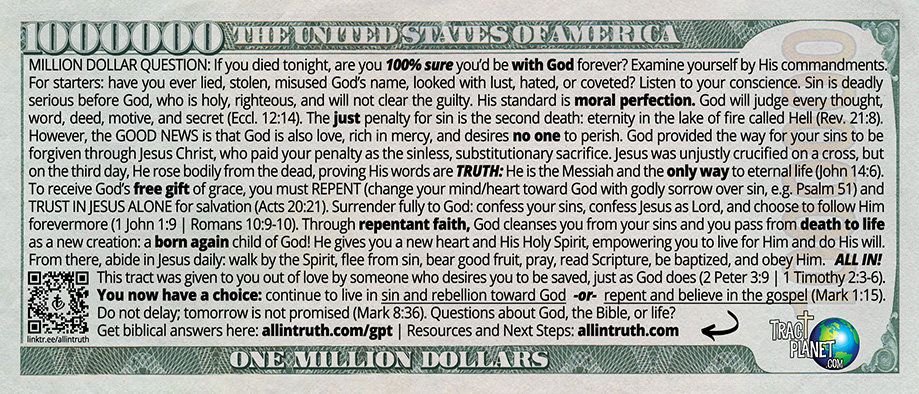
Purchase our “Million Dollar Bill” gospel tract. Send a message to support@tractplanet.com and reference you would like to place an order for the “Franklin Million Dollar Bill – Custom Gospel Tract designed by All In Truth”. You will then proceed to place the order HERE.
View the Million Dollar Bill gospel tract design: FRONT | BACK

Gospel Recap
1️⃣ Seek Truth
Jesus claims to be the only way to Heaven (John 14:6) and confirms His words are true by rising from the dead. Even today, Jesus’ life and death on a cross is not disputed. We know God exists because of creation and the Bible proves to be God’s word through manuscripts, prophecy, archeology, science, and more.
2️⃣ Repent and Trust Jesus
“For all have sinned and fall short of the Glory of God” (Romans 3:23). “For the wages of sin is death, but the gift of God is eternal life in Christ Jesus our Lord” (Romans 6:23). We have the opportunity to be saved, not by any works, but through repentance and trusting in Jesus alone for what He has done for us as atonement for our sins.
3️⃣ Death To Life
Once you repent and place your faith in Jesus as Lord and Savior, you are born again, a new creation, and have passed out of death into life (John 5:24)! Make Psalm 51:1-17 your own if you need help becoming declared right with God. Then, grow in relationship with God by daily: praying, reading/studying the Bible, and obeying what you read.
Next Steps
If you are now right with God, please visit this page to learn more Biblical principles as you follow Jesus, ALL IN.
Anonymous Feedback
Still have questions or doubts? Did you receive one of our gospel tracts at an event? Or maybe you learned something from our website and have become born again? No matter the reason, we would love to hear from you! Feel free to include your name and email so we can get back with you, otherwise this form is anonymous. You can also email us ➡️ allintruthtv@gmail.com